
Artificial Intelligence and the Rise of ChatGPT: What It Means for Learning and the Future
When ChatGPT became publicly available in December 2022, it felt like the digital world shifted overnight. Suddenly, we had a tool that could answer questions, write essays, summarize research, draft emails, and even carry on conversations that felt surprisingly human. For many, the experience was both exciting and unsettling. But ChatGPT didn’t appear out of nowhere—it represents years of development in chatbots and Large Language Models (LLMs) designed to recognize and generate human-like communication.
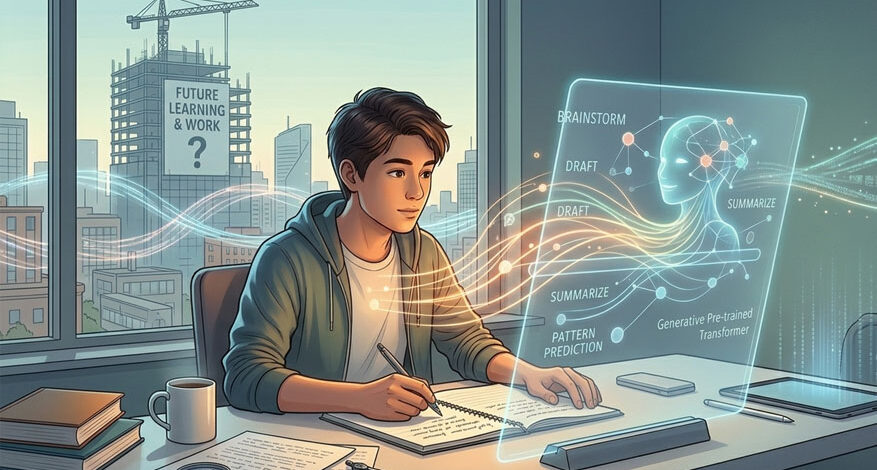
The “GPT” in ChatGPT stands for Generative Pre-trained Transformer, which simply means it predicts not just words or sentences, but full paragraphs based on patterns it has learned from massive amounts of data—everything from public forums and articles to textbooks and computer code. Impressive, yes—but also imperfect. Like all AI tools, it doesn’t always know when it’s wrong.
How ChatGPT Is Changing Learning and Work
The reactions to ChatGPT have been mixed.
Some educators worry that students may become overly dependent on AI, skipping the hard work of learning, writing, and thinking deeply. If a tool can generate an answer instantly, why wrestle with ideas for hours?
But others see enormous potential. Many professors, writers, and professionals now use ChatGPT to:
- brainstorm ideas,
- overcome writer’s block,
- generate first drafts,
- summarize dense readings,
- or spark new creative directions.
Ignoring the technology won’t make it disappear. Whether we like it or not, AI has become part of daily life—and education must learn how to respond thoughtfully.
Where ChatGPT Fits in the Evolution of Technology
In one sense, ChatGPT is the next step in a long line of digital tools—spell checkers, grammar checkers, autocomplete, and predictive text. But there’s a key difference:
- Predictive text suggests a few words.
- AI text generators create entire documents, arguments, and explanations.
And that means the old saying “Garbage in, garbage out” still applies. The quality of what AI produces depends heavily on the quality and accuracy of the information it has learned from.
The Promise—and the Problems
Like any innovation, AI comes with both benefits and risks.
For example, a research study reported that ChatGPT generated academic abstracts that fooled peer reviewers nearly one-third of the time—even when reviewers knew some abstracts were fake. This shows how believable AI-generated writing can be, but also how easily it can mislead when unchecked.
AI detection tools are improving, but they’re not perfect either. The goal cannot simply be “catching” AI use. It must be teaching students how to evaluate, verify, and think critically.
ChatGPT in Professional Fields
AI tools are also being used in medicine, law, and research. In one study of medical case reports using ChatGPT:
- 85% of cases found the tool useful, offering new perspectives.
- 96% also expressed concerns, especially around accuracy and safety.
AI can assist, but it cannot replace trained judgment or human responsibility.
Education’s Next Step: Teach With AI, Not Against It
The conversation about AI in learning is only beginning. Instead of banning AI or pretending it’s not here, educators can help students:
- learn how to use AI responsibly,
- evaluate the credibility of AI responses,
- maintain academic integrity,
- and develop strong independent thinking skills.
This is digital literacy, and it’s essential for the future.
Recent guidance for educators suggests:
- Be open and transparent when discussing AI with students.
- Use detection tools cautiously—not as the primary approach.
- Teach students to verify information and use credible sources.
- Encourage critical thinking at every stage of learning.
Helpful Ways to Use ChatGPT in Learning
Positive uses include:
- brainstorming ideas
- producing rough drafts to refine later
- summarizing complex sources
- checking grammar and clarity
- practicing editing, fact-checking, and rewriting
- using the Regenerate Response feature to compare perspectives
Possible downsides:
- less original thinking if students rely too heavily on it
- inaccurate or fabricated information
- less human creativity and engagement
- temptation to submit AI work as personal work
The goal is balance:
Use AI as a tool, not a replacement for your mind.
How to Get Better Results with ChatGPT
The questions you ask shape the responses you get. Keywords and verbs make a big difference:
|
Verb / Prompt |
What It Signals to ChatGPT |
Result |
|
Explain / Elaborate |
Provide depth | Longer, clearer explanation |
|
Discuss / Talk about |
Conversational exploration |
Interactive, thoughtful responses |
|
Summarize / Expand |
Adjust detail |
Either condensed or extended content |
| Include sources | Improve credibility |
Easier verification of facts |
Good prompts = better learning.
Final Thought
ChatGPT is powerful, but it is not magical. It does not think, feel, or understand. It patterns, predicts, and generates based on what humans have created. That means we are still the thinkers, the creators, the decision-makers.
Artificial intelligence is a permanent fixture in our lives, prompting us to consider not whether to use it but how to use it effectively.
If we approach AI with curiosity, responsibility, and integrity, it can become a tool that enhances learning rather than replacing it.
The future of education will not be about avoiding AI—it will be about learning how to learn alongside it.