
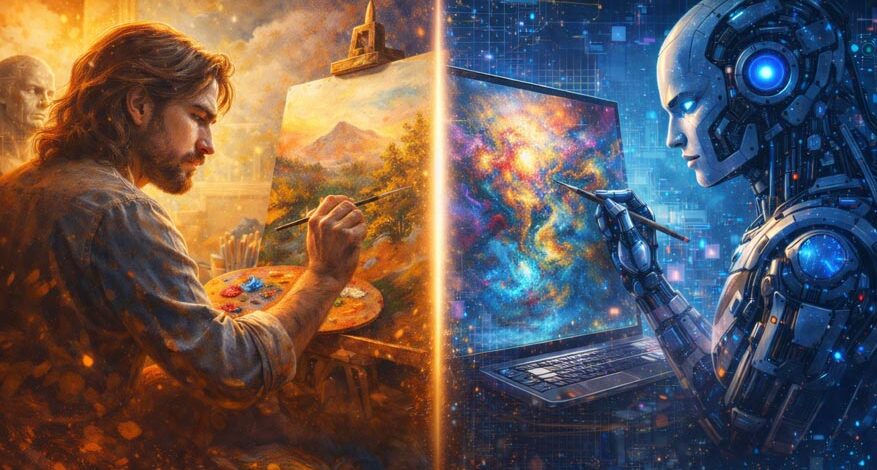
AI vs Traditional Art: How Technology Is Redefining Creativity
Let’s be honest—few topics spark as much debate in the creative community right now as AI-generated art. Ever since artificial intelligence entered the art scene, artists, collectors, and even casual observers have been wondering: What does this mean for traditional art? Is AI a threat, a tool, or maybe a bit of both?
For many artists, it feels like standing at the edge of a new artistic era. Some see AI as an exciting partner—a way to explore new creative horizons. Others fear it could overshadow the human touch that makes art so meaningful. Both perspectives matter deeply, and in truth, the story of AI vs. traditional art isn’t about one replacing the other—it’s about how both can evolve together.
The Rise of AI Art: From Algorithms to Auction Houses
Artificial intelligence has made incredible leaps in the past few years, and the art world is feeling the impact. Tools like DALL·E, Midjourney, and Runway ML allow anyone—from seasoned professionals to curious beginners—to generate stunning, complex visuals in minutes. These programs use deep learning models and generative adversarial networks (GANs) to create imagery that can mimic or reinterpret artistic styles once thought to be uniquely human.
The turning point came in 2018, when Christie’s auctioned “Edmond de Belamy,” a portrait created by an AI algorithm, for an astonishing $432,500. That sale didn’t just make headlines—it made history. Suddenly, AI art wasn’t just an experiment; it was part of the fine art market.
Fast forward to today, and AI art has become an undeniable force—reshaping not only how we create but also how we define creativity itself.
AI as a Creative Partner, Not a Replacement
While some worry that AI could replace traditional artists, many creatives are discovering that these tools can actually enhance the artistic process. Think of AI as a helpful studio assistant—one that handles time-consuming technical tasks, freeing you to focus on what you do best: creating.
Programs like Adobe Sensei, DeepDream, and Prisma now assist artists in refining compositions, experimenting with colors, and even generating new ideas. Instead of replacing imagination, AI can help spark it—offering a fresh lens through which artists can explore their vision.
Of course, this evolution raises important questions about authorship. If an AI model trained on thousands of existing artworks produces something new, who is the artist? The coder? The prompter? Or the algorithm itself? These are questions that the art world—and the legal system—are still wrestling with.
How AI Is Disrupting the Art Market
Traditionally, the art market has been built around galleries, museums, and auction houses that value reputation, history, and scarcity. However, AI is revolutionizing this model.
Now, artists can sell directly to collectors through digital marketplaces and NFT platforms like OpenSea and SuperRare. AI-generated pieces are authenticated on the blockchain, ensuring ownership and originality in the digital realm. For many creators, this new pathway has made art more accessible and profitable than ever.
At the same time, the demand for AI-generated art is growing rapidly. Companies are commissioning custom AI artworks for branding and advertising, while collectors are adding algorithmic pieces to their portfolios. AI’s ability to create visually stunning, tailored works quickly makes it especially appealing in commercial and digital spaces.
But this shift doesn’t mean traditional art is fading. In fact, it’s sparking renewed appreciation for physical materials—paint, clay, pencils, and canvas—the tangible tools that carry human touch and texture in ways machines simply can’t replicate.
Ethical, Copyright, and Legal Questions Around AI Art
As AI continues to evolve, it’s also stirring up deep conversations about ethics, ownership, and authenticity.
One of the biggest questions is copyright. When an AI artwork draws from massive datasets of existing images, who owns the final product? The developer of the algorithm? The user who prompted it? Or the original artists whose work helped train the model? The law hasn’t caught up yet, and until it does, the boundaries will remain blurry.
Then there’s the emotional aspect. Traditional art carries the weight of lived experience—the joy, pain, and passion of being human. AI art, on the other hand, is driven by patterns and data. It can imitate emotion beautifully, but it doesn’t feel it. That lack of consciousness leaves some viewers questioning whether AI-generated images can ever truly replace the soulfulness of human-made art.
The Future: Collaboration, Not Competition
Despite the tension, the future of art doesn’t need to be an “either/or” scenario. The most exciting space lies in the middle—where AI and traditional artists collaborate.
Many contemporary artists are blending the two worlds, using AI tools to brainstorm compositions or generate references that they later interpret by hand. This combination of technology and traditional craftsmanship is creating new creative spaces.
Museums and galleries are beginning to catch on, too. Exhibitions dedicated to AI-generated art are appearing alongside classic collections, prompting visitors to reflect on what creativity truly means. And while some curators remain skeptical, most agree that AI isn’t going away—it’s simply becoming another tool in the ever-expanding artistic toolbox.
Final Thoughts
Artificial intelligence is changing the art landscape in profound and fascinating ways. It challenges long-held ideas about what it means to be an artist while also expanding the possibilities of creative expression. The growth of AI-generated art doesn’t make traditional methods less valuable; it makes them more valuable.
As we move forward, the real opportunity lies in balance—in using AI to enhance, not erase, the human touch that defines art at its core. Because no matter how advanced technology becomes, creativity will always begin with the spark of human imagination.