
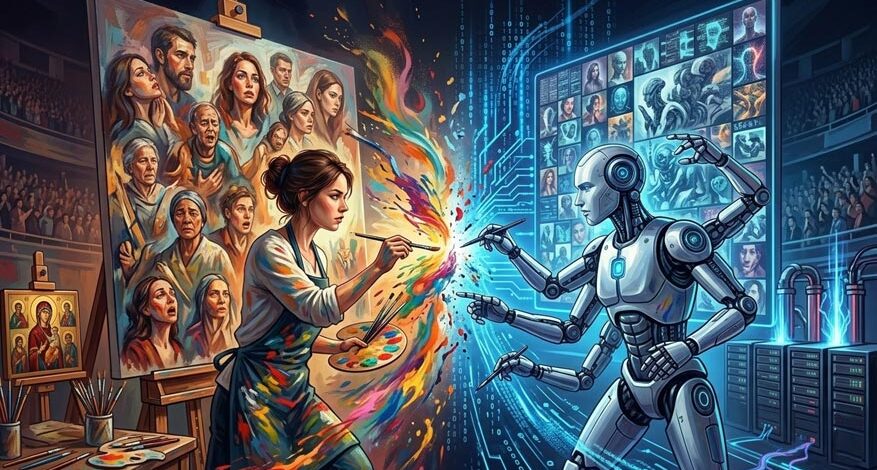
Can AI-Generated Art Truly Replace Traditional Artists?
I used to daydream about how nice it would be to press a single button and watch my artwork magically appear on a blank canvas. No smudged lines, no hours of sketching — just instant art. But as artificial intelligence has entered the creative scene, I’ve realized something powerful: the true joy of creating art doesn’t come from the finished piece. It comes from the process — the messy, emotional, soul-filling journey of making something with your own hands.
AI-generated art might be fast and fascinating, but it can’t replicate that sense of connection, accomplishment, or calm that traditional art brings. Painting, drawing, sculpting — they’re not just creative outlets; they’re therapeutic experiences that ground us in the present moment. And that’s something no algorithm can simulate.
The Ongoing Debate: AI Art vs. Traditional Art
The art community has been buzzing about AI-generated art for a while now. Some see it as the next great innovation, while others fear it’s devaluing the human touch that defines creativity. Personally, I don’t believe typing a prompt into a generator makes someone an artist. Sure, prompt-writing requires some skill and imagination — but the emotional fulfillment that comes from physically creating something from scratch? That’s irreplaceable.
AI doesn’t truly create new art; it recycles what already exists. It draws from vast datasets of human-made images, blending and remixing them into something that only feels original. As humans, we have the extraordinary ability to tap into inspiration — to connect with something bigger than ourselves and express thoughts and emotions in ways that machines simply can’t.
The Disappointment Behind the Discovery
When AI programs first started generating anime and manga-style images, I’ll admit — I felt frustrated. These were styles I had spent years perfecting through trial, error, and practice. Suddenly, anyone could type a few words and produce something that looked similar to the work I’d labored over for years.
It felt unfair, like the time and patience I had poured into developing my craft were being undermined by convenience. But curiosity got the better of me, and I decided to give AI art a fair chance — to explore what it could actually do.
Experimenting With AI Art Generators
When I finally tried tools like Midjourney and Playground.ai, I was impressed — at least at first. Creating simple character portraits was surprisingly easy. AI could imitate different artistic styles, lighting, and textures almost instantly.
But once I tried generating complex scenes — with multiple characters or intricate poses — the flaws became obvious. I started seeing strange errors: extra fingers, misplaced limbs, blank eyes, and even double heads (which I jokingly call “hat heads”). And for some reason, AI still can’t seem to draw realistic hands.
Learning to write better prompts helped improve the results. I followed tutorials, analyzed other people’s prompts, and made lists of attributes I wanted or wanted to avoid. Over time, my results got cleaner and more cohesive. But even then, the process never gave me the same emotional satisfaction that painting or sketching by hand does. It was fun — but not fulfilling.
Prompt Writing vs. True Artistry
Let’s be honest — prompt writing is its own creative skill. It takes thought, precision, and experimentation to get a desired result. But it’s closer to writing than to painting. That’s why it’s only fair that AI-generated art, digital art, and traditional art are treated as separate categories — especially in exhibitions and competitions.
While some prompt engineers can fix AI’s visual mistakes through re-runs or image editing, a traditional artist does this intuitively, in real-time. When I draw, I adjust proportions, correct shapes, and refine details with my own hands. Every line is a choice, every correction a part of my journey. That’s where the art lives — in the moments between imperfection and intuition.
AI Art: Recombination, Not Creation
One of the biggest misconceptions about AI-generated art is that it’s “creative.” In truth, these programs don’t invent anything new. They analyze and recombine millions of existing images — blending styles and elements into something that looks original but isn’t born from emotion or intent.
That doesn’t mean AI art is theft, as some claim. The datasets are so vast that no single artist’s work is directly copied. Still, AI art lacks the spark of originality that comes from a human hand and a human heart.
Artists draw from emotion, culture, memory, and imagination. AI draws from data.
The Temptation of Instant Gratification
In today’s fast-moving, productivity-obsessed world, it’s easy to see why AI art has caught on. Businesses want speed. Studios want efficiency. Consumers want instant results. For commercial uses — like logos, blog images, or ad visuals — few people care who created the image, as long as it looks good.
That’s something I explained to my teenage son recently. If he wants a career in art, he’ll need to understand both worlds: how to draw by hand and how to use AI tools. Studios are already looking for artists who can do both — blending creativity with technology to meet tight deadlines.
But when it comes to fine art, to expression, to storytelling — AI simply can’t replace the human experience. It can replicate style, but not soul.
The Future of Art: Collaboration, Not Competition
So, can AI replace traditional artists? I don’t think so. But it can reshape the creative process. Tools like Midjourney, DALL·E, and Playground.ai can serve as reference generators or brainstorming assistants — helping artists visualize ideas faster or explore new compositions.
However, it’s important to remember that under current U.S. copyright laws, AI-generated works can’t be copyrighted. That means your AI creations could be reused without your permission — a major risk for anyone relying solely on these tools.
Ultimately, I believe the future of art lies in collaboration — between human intuition and machine capability. AI can enhance creativity, but it can’t replace the human connection to beauty, struggle, and meaning. No matter how advanced algorithms become, they’ll never have that spiritual spark — the one artists have been channeling for centuries through paint, pencil, and passion.
In the End, Creation Is Its Own Reward
Learning to draw, paint, or sculpt takes time, patience, and persistence — but that journey is what makes art so meaningful. Every brushstroke teaches you something about yourself. Every finished piece carries a story that’s entirely your own.
AI might be fast, but art isn’t supposed to be easy. It’s supposed to be alive. And that’s something no machine can ever truly replicate.
(Note: The images featured in this article were created using a blend of AI-generated art and Photoshop. I always strive to label my AI-assisted work for transparency.)