
Boosting Your Personal Innovation Capacity: Why Iteration Changes Everything
If you’ve spent any time around innovators lately, you’ve probably heard one word repeated so often it starts to lose meaning: iterate.
- Iterate your product.
- Iterate your strategy.
- Iterate your business model.
In some circles, it’s practically a mantra.
And honestly, there’s a good reason for that. Iteration is the backbone of innovation. It’s how we learn what works, what doesn’t, and what might become the next breakthrough if we’re willing to refine it just one more time. It’s hands-on, messy, and grounded in the understanding that real progress comes from testing ideas against the world—not just thinking about them in our heads.
Iteration isn’t only about upgrading products and services. It’s about upgrading our thinking.
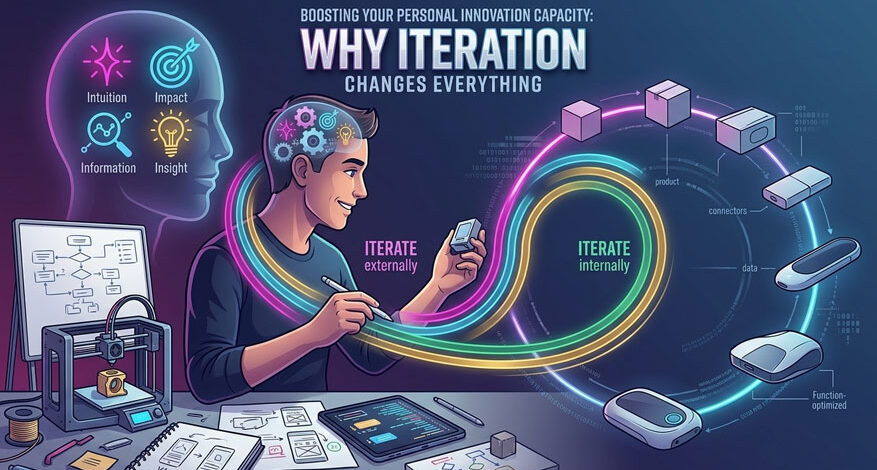
Here’s the part people don’t talk about nearly enough. If you look closely at people who innovate consistently—not just once in a lucky moment—you’ll notice something powerful: they’re constantly revising the way they see the world. They’re iterating internally just as much as they iterate externally.
That inner iteration is powered by what I call the four “I”s: Intuition, Impact, Information, and Insight.
Let’s break them down.
- Intuition: Opening the Door to New Possibilities
Every innovative idea begins with a spark—some nudge that pushes you beyond what you already know.
Developing intuition means intentionally expanding your imagination, giving yourself permission to wander outside familiar boundaries, and letting possibilities—even rough ones—surface.
It’s the courage to ask, What else could be true? What else could I try? What haven’t I thought of yet?
- Impact: Moving From Ideas to Action
Innovation doesn’t happen in your notebook. It happens when you take a chance on a possibility you’re not fully sure about yet.
Impact means experimenting, building prototypes, making calls, running small tests—anything that moves your idea from imagination into the world. It’s choosing action even when the outcome is fuzzy. And it’s one of the most defining traits of successful innovators: they are willing to try.
- Information: Paying Deep Attention to What Reality Tells You
Once you act, the world responds. Maybe not loudly, but it always responds.
This phase is about watching carefully—without defending your assumptions. Innovators tune in to anomalies, surprises, odd reactions, unexpected successes, and weird failures. They notice the small things most people overlook.
Because inside those exceptions is often the clue that leads to the next breakthrough.
- Insight: Making Meaning Without Jumping to Conclusions
Insight doesn’t come from gathering more data—it comes from interpreting that data in a flexible, curious way.
This means resisting the urge to cling to the first explanation that feels comfortable. It means exploring multiple interpretations, considering unusual angles, and asking, What might this really be telling me?
Insight is where learning becomes clarity—and clarity becomes your next iteration.
Iteration Is Really a Cycle—And You Get to Choose Which One You’re In
These four steps don’t happen once. They happen repeatedly, forming an Innovation Cycle.
But here’s the twist: there are two very different cycles you can fall into.
Cycle 1: The Knowledge Loop (the comfort-preserving loop)
This loop keeps you exactly where you already are:
- You rely only on what you already know.
- You do what you’re already confident will work.
- You look for proof that your assumptions were correct.
- You interpret new information in ways that reinforce your existing beliefs.
It’s stable, predictable… and non-innovative.
Cycle 2: The Insight Loop (the growth-producing loop)
This loop continually expands your thinking and creativity:
- You generate new possibilities.
- You test them—even when unsure.
- You pay attention to surprises instead of ignoring them.
- You explore new interpretations and meaning.
This is the loop that creates momentum. This is the loop that fuels personal innovation capacity.
The Loop You Choose Becomes the Loop You Live In
One of the most important findings from innovation research is this:
Each choice reinforces the next one.
If you choose the comfort of the Knowledge Loop once, you’re more likely to choose it again.
If you choose the curiosity of the Insight Loop once, you’re more likely to choose that again.
Over time, these repeated choices turn into habits. And those habits shape your identity as an innovator—or keep you stuck in place.
What’s empowering is that these patterns can be measured. They’re not mystical or random. They’re choices we make, often unconsciously, but choices nonetheless.
Which means we can change them.
Becoming More Innovative Is About Making Different Choices
With the right kind of feedback—and sometimes just the right kind of awareness—anyone can shift toward more innovative ways of thinking. Individuals, teams, and entire organizations can learn to choose curiosity over certainty, exploration over rigid control, discovery over validation.
Iteration isn’t just a method. It’s a mindset.
And the more we iterate on our own thinking, the more naturally we begin to innovate in everything else.