
Break the Mold of Fear and Engage in the Mystery of Creative Discovery
Stop Overthinking and Create From the Heart
If there’s one thing that can crush creativity faster than anything else, it’s overthinking.
We start worrying about whether it’ll be good enough, how it’ll look, or what others will think—and suddenly the joy disappears.
But here’s the truth: creativity doesn’t live in your head—it lives in your heart.
It’s not about control; it’s about curiosity, emotion, and the courage to explore the unknown.
“Don’t think about making art, just get it done.
Let everyone else decide if it’s good or bad, whether they love it or hate it.
While they are deciding, make even more art.”
— Andy Warhol
The Indian mystic Osho once said that creativity is a state of “no-mind.” When you’re fully present, open, and free from mental noise, creativity flows effortlessly.
Here’s how to quiet that overthinking voice and reconnect with your intuition—so your art can flow as naturally as breathing.
1. Start Before You’re Ready
Stop waiting for the perfect moment. Don’t overplan. Just begin.
Neuroscientist Dr. Charles Limb, who studied jazz musicians during improvisation, discovered something fascinating: when they enter a state of creative flow, the part of the brain responsible for self-monitoring quiets down. In other words, thinking less allows the art to speak more.
The next time you hesitate, remember this—creativity thrives on play, not perfection.
2. Use What You Have
You don’t need fancy supplies or a perfect studio setup to make art.
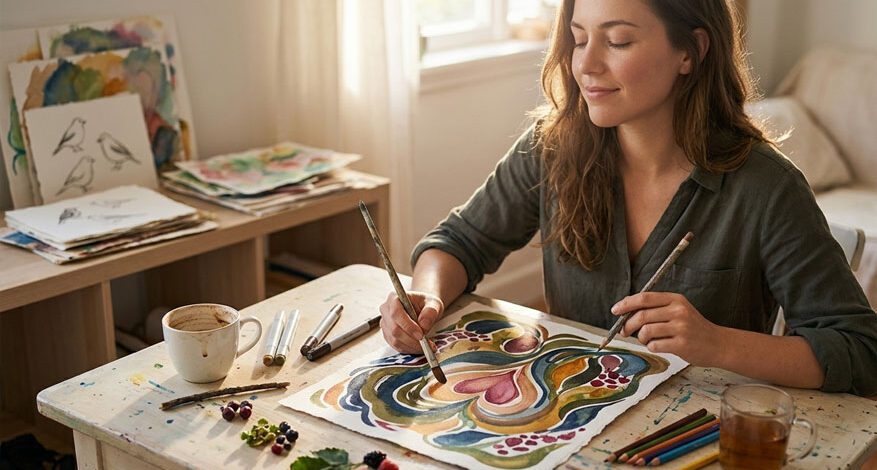
Grab what’s around you—pencils, markers, coffee, tea, even berries. Some of the most soulful pieces have been created from humble materials.
Waiting for “the best tools” is often just another clever form of procrastination.
Start with what’s in front of you, and your creativity will find a way.
3. One Step at a Time
When you think about the whole project, it can feel impossible.
But when you focus on just the next step, everything becomes lighter.
Anne Lamott tells a story in Bird by Bird about her brother trying to finish a massive report on birds. Overwhelmed, he was ready to give up—until their father said gently, “Bird by bird, buddy. Just take it bird by bird.”
That’s creativity in a nutshell: small, consistent steps add up to something extraordinary.
4. Embrace the Unknown
You don’t need to know how it will all turn out. In fact, mystery is what makes creativity thrilling.
Author E.L. Doctorow once compared writing to “driving at night in the fog.” You can only see as far as your headlights, but that’s enough to keep moving forward.
Art is the same way. The not-knowing keeps it alive. As Georgia O’Keeffe said, “Making your unknown known is the important thing—and keeping the unknown always beyond you.”
5. Give Yourself Permission to Play
Children don’t question their creativity—they just play. They scribble, sing, dance, and invent worlds without a hint of judgment.
That’s what art should feel like: freedom.
Don’t take your work—or yourself—too seriously. The more you play, the more your authentic style will emerge.
6. Let the Mess Happen
A spotless studio might look great on Instagram, but creativity often thrives in beautiful chaos.
Research by Kathleen Vohs found that messy environments can actually spark more original ideas. People surrounded by creative clutter came up with five times as many inventive concepts as those in tidy rooms.
Even the legendary painter Francis Bacon created masterpieces surrounded by piles of books, paint tubes, and scraps of paper. His studio looked chaotic—but inside that mess lived genius.
So don’t clean up your inspiration. Let the mess breathe.
7. Connect With Your Intuition
Before you dive into your art, take a few minutes to get grounded. Breathe deeply. Stretch. Meditate.
Try drawing an Ensō circle—a sacred Zen symbol of enlightenment and presence.
Paint it in one spontaneous stroke. No corrections, no overthinking.
Whatever emerges is perfect because it reflects a single, unrepeatable moment of truth.
That’s what creativity is about—honoring the moment as it is.
8. Warm Up With Loose Sketches
When you loosen your body, you loosen your mind.
Try quick, timed gesture sketches—30 seconds to two minutes. These warm-ups free you from the need to “get it right” and reconnect you with the joy of movement.
You can even throw them away afterward. The goal isn’t the result—it’s the release.
9. Let Music Guide You
Music has the power to pull you out of your head and into your flow.
Put on songs that make you feel alive—ones that match the energy you want in your art.
Melody calms overthinking and helps your creativity move in rhythm.
10. Silence the Inner Critic
That voice in your head that whispers “this isn’t good enough”? It’s lying.
Tell it kindly, “Not now. I’m busy creating.”
You can critique later. Right now, you’re here to express, not impress.
As Sylvia Plath wisely said, “The worst enemy to creativity is self-doubt.” Don’t give that voice power it doesn’t deserve.
11. Trust the Process
Art is an act of faith.
You won’t always know where you’re going, but you have to believe the path will unfold as you go.
Every painting, every song, every paragraph—it’s all a journey.
Some days will feel messy and uncertain, but that’s where growth happens.
Art isn’t about the destination—it’s about the experience.
12. Forget the Rules (for a While)
Once you’ve practiced enough, let go of what you’ve learned.
Mark R. Leary, author of The Curse of the Self, found that when experts overthink their technique, their performance actually suffers.
So trust your muscle memory. Let instinct take the lead.
The knowledge is already inside you—give it room to breathe.
13. Create What You Want to Create
Not what you should create. Not what others expect.
Make what excites you, scares you, heals you.
Art is a mirror for the soul—so let yours speak.
Because when you create from genuine inspiration, that truth resonates with others more deeply than any trend ever could.
Final Thoughts: Step Into the Unknown
Fear will always whisper reasons to hold back. But the only way to silence it is to keep creating anyway.
Art isn’t about perfection—it’s about presence.
It’s about showing up, trusting your intuition, and letting your heart lead the way.
So grab your brush, your pen, your clay—whatever calls to you—and start.
Because every masterpiece begins the same way: with one brave, imperfect step.