
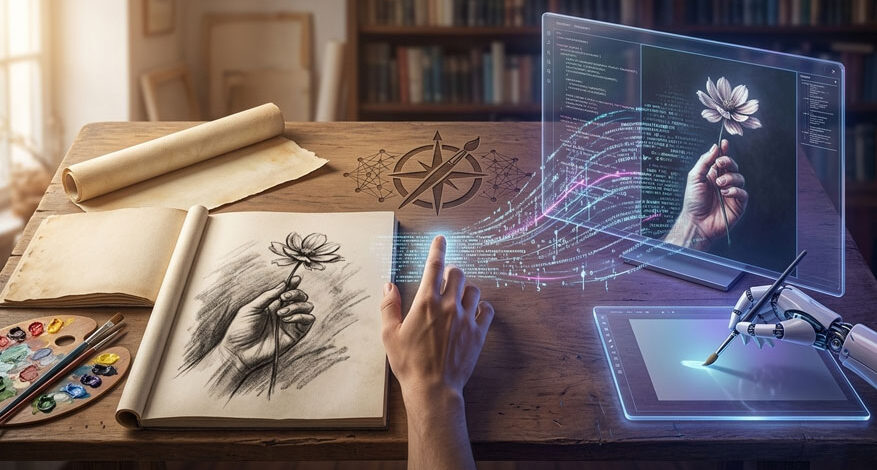
Preserving The Timeless Value and Essence of Traditional Art in the Age of AI
In today’s ever-changing art world, we’re standing at a fascinating crossroads. On one side lies the enduring beauty of traditional art—the soft pull of a paintbrush, the scent of oil pigments, and the comforting scratch of pencil on paper. On the other hand, we see the rapid rise of artificial intelligence, reshaping how art is made, shared, and even understood. The question many artists and collectors are asking is simple but profound: In the age of AI, does traditional art still matter?
The answer for anyone who has ever held a brush, shaped clay, or lost themselves in the quiet rhythm of creation is a resounding yes.
The Irreplaceable Magic of Traditional Art
There’s something sacred about art that’s born from the human hand. The texture of watercolor paper, the steady drag of charcoal, the way color blooms and blends unpredictably — these tactile details connect the artist not only to the work but to the moment itself.
Traditional art holds a heartbeat. Every brushstroke carries emotion; every imperfection tells a story. You can feel the artist’s mood, their patience, their quiet triumphs in the layers of paint and texture. That human touch — that soul — is something no algorithm can replicate.
Unlike pixels and code, traditional art invites you to slow down and experience. It’s not about perfection; it’s about presence.
AI Art: Innovation Meets Imagination
Artificial Intelligence has undeniably changed the creative landscape. Tools like DALL·E, Midjourney, and Stable Diffusion have given rise to a new form of digital artistry — one where words alone can generate breathtaking visuals in seconds.
AI art can mimic styles, suggest compositions, and even inspire artists to think differently. It’s an incredible innovation — one that opens doors to those who may not have formal training but still want to explore visual storytelling.
Yet, as fascinating as AI-generated art may be, it lacks one thing: emotion. While it can analyze, combine, and replicate, it cannot feel. It doesn’t experience the hesitation before a brushstroke or the satisfaction of seeing a vision come to life after hours of dedication. That deeply human element — the vulnerability and joy of creation — remains uniquely ours.
Why Traditional Media Still Matters
Despite the advances of digital art and AI, traditional media continue to offer something profoundly meaningful—something that reminds us what it means to be human.
- A Connection to Our Heritage
Every time an artist picks up a brush, they’re continuing a conversation that began centuries ago. Traditional art connects us to our cultural roots—to the masters who came before us and to the timeless beauty of craftsmanship passed down through generations.
- A Tactile, Sensory Experience
There’s a physical intimacy in creating with real materials—the feel of rough canvas beneath your fingers, the sound of pencil scratching across paper. These sensory experiences are grounding and deeply personal, offering a kind of mindfulness that digital tools can’t reproduce.
- Perfectly Imperfect Expression
Traditional art celebrates imperfection. Smudges, uneven lines, and spontaneous “happy accidents” often become the most memorable parts of a piece. These imperfections aren’t flaws — they’re fingerprints of authenticity, traces of the artist’s humanity left behind in the work.
- A Path to Mindfulness and Healing
Painting, sculpting, or sketching encourages presence. The repetitive movements and focused attention can quiet the noise of the world, creating space for reflection and peace. Many artists describe the process as meditative—a sanctuary for the soul.
Embracing the Future While Honoring the Past
AI isn’t the enemy of art — it’s simply the newest tool in our creative toolbox. Just as photography once expanded artistic horizons, AI can also inspire fresh perspectives and possibilities. But tools should never replace the heart of creation — only amplify it.
The future of art doesn’t have to be a competition between humans and machines. It can be a collaboration where technology enhances efficiency and imagination, while traditional art keeps us grounded in authenticity and emotional truth.
As artists, collectors, and admirers, it’s up to us to keep these traditional practices alive—to teach them, share them, and celebrate them. Because while AI may generate images, only humans can create meaning.
Final Thoughts
In the age of algorithms and automation, traditional art stands as a quiet rebellion—a reminder that true beauty comes from the human spirit.
AI may change how we create, but it will never replace why we create. Whether you’re a painter, sculptor, or simply an admirer of handmade art, remember this: technology can imitate, but it can’t feel.
And it’s that emotion — raw, imperfect, deeply human — that keeps traditional art timeless.
